Lessons I Learned from the Birds....by Heather Salinas
Protect your young, but know when it's time to let go.
Birds are fiercely protective of their young. The mockingbird is
one of the most aggressive birds when it comes to a nest of her hatchlings. A
nesting mockingbird will stop at nothing to protect her young from potential
predators, large and small. They are often seen "dive-bombing"
uninvited visitors - even predators like hawks, owls and large dogs! Similarly,
the Killdeer have been seen "faking"a broken wing to distract a
potential predator coming too close to a nest. A nesting Killdeer would
willingly sacrifice herself to save her young. I'm sure we can all relate to
this!
 |
| Name that bird, spotted this summer in the Gruener's backyard. |
Alternately, there comes a time when mother bird instinctively
knows nature's clock has chimed and her young must flee the nest. She bravely
watches on as her young attempt to fly for the first time. At times, her
hatchlings do not make it. As difficult as it is for her to look on, she must
let them go into nature and fend for themselves -- become independent. Too many
of us try to solve our children's every problem and shield them from
disappointment. While I am sure this is with good intention, our children must
also learn to become independent and eventually learn to meet their own
emotional needs while we are still close by. With young children, it will take
much discernment about when to step in. We should calibrate
"help" to complement rather than substitute for our child’s efforts.
 |
| A squirrel scavenging nature's buffet from our garden through the breakfast nook window. |
Eat only what you need.
Birds, unlike the squirrels -- nature's scavengers -- do not store
food for the winter. When spring has arrived and nuts, berries and worms are
plentiful, they happily enjoy nature's buffet, but live in the moment. They do
not take more than they can eat, even to store away in anticipation of winter.
When winter comes, albeit food sources scarce, birds remain transfixed on the
hope that God will provide. How difficult it is for us as humans to do this. So
often we feel that a higher income, bigger home, heftier bonus -- more nuts and
berries -- will make us happier. Enough is never enough.
 |
| Click image for source - Wild Delight site. |
It's ok to stand out.
I often think what a magnificent artist God must be to have
created visual perfection like the painted bunting, roseate spoonbill,
rose-breasted grosbeak, yellow warbler......or any number of birds in breeding
plumage! These birds are beautiful and breathtaking, not because they fit this
mold of perfection, but because they are different and stand out. Ian Wallace,
a children's book author, says, "Why are you trying so hard to fit in,
when you were born to stand out." Has there even been a statement more
true? Each of us, like the magnificent winged creatures, were each born to stand
out. Why fight it?
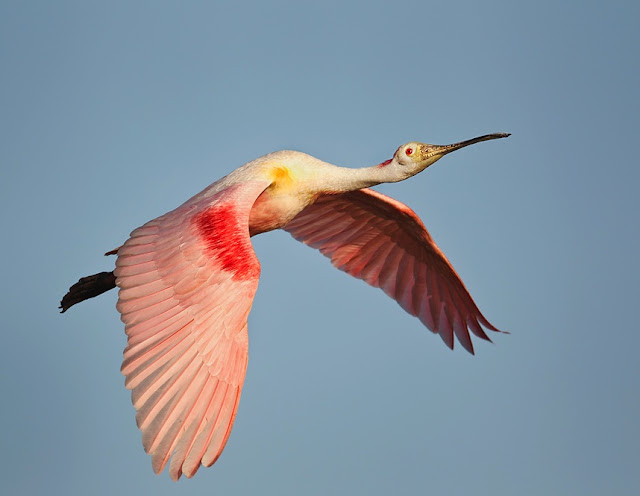 |
| Click image for source - Birds As Art blog. |
It's not all about ME.
Look into the sky and you will rarely -- if ever -- see a single
goose. A flock of geese commonly flies in a "V" formation because
this formation serves to distribute the difficulty of travel. The goose at the
center point of the "V" must face the most strain, since it meets the
greatest wind resistance in flight. To account for this, that central position
is rotated every few minutes so that the geese can fly incredible distances
without rest.
 |
| Photo courtesy of NASA |
Furthermore, the least challenging position is at the back of the
"V". This position is reserved for the young, weak or old birds.
Here's the interesting part: If a goose becomes too tired or ill to continue,
it is never left alone or abandoned. The bird will leave the flock with the
assistance of a stronger bird, and remain grounded until it can continue
flight. And the “honking” of geese is believed to be the method of the strong
encouraging the weaker birds to continue! Do we do that? Do we stay back with a
buddy that's having a difficult time, or are we too focused on our own outcome?
If someone we know needs some encouragement, do we go out of our way to
"honk" for that person, or sit back and gossip about it or think
someone else will step up to help?
Author’s Note: My name is Heather Salinas and I thank
you all so much for reading. I have been married for eight years and have
three young children, two dogs, two fish, a bird, soon-to-be eight turtles, and
a yard full of wildlife! I have always had a fascination for nature and all of
God's creatures. I could literally spend hours watching wildlife in its natural
habitat.
I earned a Bachelor of Arts degree from Southwestern University in
2002, and a Master of Science Degree in Journalism from Quinnipiac University
in 2004. I have been an adjunct writing instructor at Alvin Community College
for the past five years, although I am on leave this semester to spend time
with my baby, Crew. I love interacting with my students and giving them an
outlet to tell their stories. Community colleges are extremely diverse and rich
in culture and backgrounds, and it's such a blessing to be able to make a
difference in a student's life :-) On a part-time basis, I also edit court
transcripts for Harris County.





