
The Corner On Character: diversity
Showing posts with label diversity. Show all posts
Showing posts with label diversity. Show all posts


Illuminating Hope
diversity,
gratitude,
hope,
light,
reflections
6.01.2020

Spectacular Picture-Book Picks
Today I'm thinking about all of the picture books I've added to my shelves
this summer as we gear up for the 2019-2020 school year.
How many of these beautiful gems do you already have?

Fostering A Can-Do Spirit
attitude,
books,
compassion,
diversity,
empathy,
grit,
growth mindset,
kindness,
perseverance,
podcast
7.19.2018
Today I'm excited because I was invited to talk about empathy, compassion and kindness on this Kindsight 101 Podcast. It was such a delight to visit with Morgane, the interviewer, who crafted insightful inquiries and totally knew her stuff. Grab some coffee or tea and click the image below to listen in.

I'm also tickled because my stuff is almost completely out of boxes from my move out of our Leadership Central learning lab. True story, it's very hard for me to let go of things, especially the hand-made cards of gratitude and love in my Smile File from my superheroes and ideas I thought I might need one day, like this ring that we picked up over a decade ago, when the kids and I took a Developmental Assets Walk with the Bay Area Alliance through Challenger Park.

I'm pretty sure there were eight beads, because the idea was to stop at eight stations along the way, one for each of the Asset categories, and collect beads while talking with the person at that station about that Asset. I figured we could easily adapt this to our six-pillars framework, so I saved the beads that most closely aligned with our true colors and put it in a box with so many other treasured ideas, to try it one day. I advocated for a Pillar Power Walk many times, but to no avail. Still I kept this idea, perhaps for such a time as this.
How would you use it in your character building? Could you give out beads as students go through your core values lessons? Could you host a Family Character Night and give families an opportunity to make these together? Could students collect beads with every stop on campus (classroom, library, music room, STEAM lab, etc) that they visit at Open House? Could there be a certain colored bead to align with the emotions or skills they've attained? Unlimited possibilities for these colorful rings that students can hang on their backpacks or use as a keychain.
Today's picture book pick of the week by Julia Finley Mosca and Daniel Rieley came in the mail yesterday and I'm pretty jazzed about it, possibly since I always figured I wasn't a math person. {Turns out there's no such thing.}
And probably because it's such an inspirational read.

Meet Raye Montague.
She's a woman.
She has dark skin.
And she's a whiz at math.
Back when she was growing up,
those three things didn't add up.
It was during a time when inequality was amped up.
In fact, her genius was over and over again passed up.
But this can-doer never gave up.
This is her success story, spotlighting her big big dreams, how hard she worked to become an engineer, and what she endured and overcame to get the recognition she'd earned as the first person to design a ship using a computer. Check out this growth-mindset title; it'll inspire your can-doers to reach higher and never give up.
Our chapter book of the week was buried in my boxes
of stuff because I'd taken it to school to share it with
a few of my students and suggest it as a summer sizzler.

I even had this bookmark that my friend Paisley made for me
hanging out on the title page, to remind me
to share it with you, dear reader.
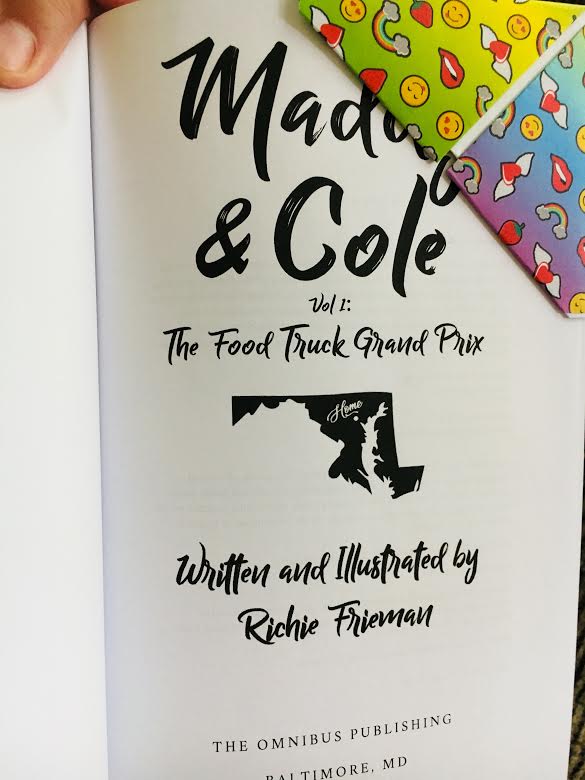
But it got lost in the move, until yesterday.
It's a Fantástico race in a Grand Prix of the Food Truck kind,
which I struggled a little bit to explain to one of my
students on the autism spectrum as I was recommending it.
He couldn't understand how Food Trucks could go fast. At all.
Anyway, in this tasty treasure by Richie Frieman,
Maddy dreams of buying herself a bike
and sees entering the Food Truck competition
with her brother Cole and her grandfather Pop Pops
as an avenue to make that dream come true.
This savory intergenerational tale finds the trio overcoming incredible odds and slowing down to go fast over
those proverbial speed bumps in the road of life
to reach the finish line and realize those dreams.
Maddy finds out that it's going to take
a can-do attitude,
a whole lot of perseverance and grit,
and a little bit of magic.
Even unkind Kenny, one of Maddy's obstacles,
might soften and sweeten a bit on the Prix path.
Check out this book; I predict it'll win a spot on your heart.
What are you go-to strategies for helping cut through I can't

and fostering a can-do spirit in your learners?

PPBF: Elmore
books,
celebrating differences,
diversity,
writing
3.30.2018
Today I'm excited because I've found a picture book so special that
I'm coming out of my self-imposed PPBF retirement to showcase it.

Title: Elmore
Author and Illustrator: Holly Hobbie
Publisher: Random House Books For Young Readers
Birthday: January 30, 2018
Suitable for ages: 3-7 (and up!)
Themes: Making friends, celebrating differences, writing
Opening page:
Elmore lived by himself in an ancient maple tree. He loved it there.
Brief Synopsis: Elmore is a precious little porcupine who doesn't mind living alone, but the loneliness he feels ultimately finds him desperate to find some friends. Because he's so prickly, however, the other animals are kept at quill's length. Will he find a way to invite them into his world despite their differences?
Resources:
Check out the Publisher's website {here}
Why I like this book: So many reasons! First, it was a gift from my friend Heather Elmore, the counselor at Westwood Elementary. I spotted it a few weeks back when I visited her (in my old office) and fell instantly in love. As I was thumbing through the pages of her namesake treasure, falling deeper with every turn, she got online and ordered it right there for me.
Second, the charming illustrations absolutely reeled me in.
Third, Elmore doesn't wallow in his problem; instead, he takes steps to creatively solve it. I absolutely love that he uses the power of the pen to create a Friends Wanted sign and ultimately find those friends by sharing a bit of himself in a creative twist.
Set up the story with the Folkmanis porcupine puppet;
click the image below to order one just like ours.

If your students are like mine,
they will adore with this spikey little guy.
Talk with them about what it might feel like to be prickly ...

or what it means to needle someone.
Dig into the rich text and find other unique vocabulary words
that students could illustrate and/or discuss.
Why does the author call Elmore's home an ancient tree?
Is there a play on words when she tucks him into his snug hollow?
Does solitude always equal boring?
When is the last time you felt all tuckered out?
In the story, Elmore recalls that his mom told him that the L in his name stands for love. Ask your students to buddy buzz with a partner and share what they know about how they got their names.
Use Elmore's writing idea as a springboard for unleashing the power of the pen. You might even seek out another class either in your school or beyond your school's walls to invite them to be PenPals.
Consider this example from a fourth-grade superhero
who understands the power of the pen
and uses it so eloquently.

On my first day back after a week of being out of the office caring for my Dad, one of my friends seeks me out before school and hands me this beautiful treasure for my Smile File, folded up like a fan and sealed in a Ziploc baggie. Is that not the most beautiful gift? Pull out a note that someone wrote to you, read it aloud, and ask students how they think it made you feel. Invite them to share a time that they've used their words to step into someone's story, uplift them just a little, and change the direction of their day. Encourage them to write or draw something for someone to make an ordinary day extraordinary,
like the note you share did for you,
like Miah's note did for me,
like the note that Elmore found tacked to his cozy dwelling
at the end of this tale
did for him.
Are they social or solitary?
Are they nocturnal?
What do they eat?
Do they have predators?
Compare and contrast what you discover about real porcupines
with how the author portrays the fictional Elmore.
Check out this incredible newcomer;
I predict you'll truly treasure this Holly Hobbie masterpiece.
No More Noisy Nights And More
belonging,
books,
diversity,
friendship,
patience,
perseverance
10.14.2017
As we gear up for Literacy Night on Tuesday, I'm excited to share three new-to-me titles that have made their way into my hands and heart in the last few months.
1. Here's the latest treasure by Flashlight Press.
 |
| Click the image for a sneak peek inside the book. |
Jackson, the well-mannered (and dare I say absolutely adorable) mole, is moving to a whole new hole underground. As if moving weren't stressful enough, he hears these noises that are keeping him from getting a good night's sleep. When he asks his emboldened boarders to kindly keep it down, their inquires about what they might do as an alternative to making noise get Jackson's problem-solving juices flowing. Is there a quiet-time activity they could do that wouldn't jeopardize his beauty rest? See if Jackson's creative ideas in this dreamy newcomer can strike a chord so that he and his 'new friends' can live in harmony and sleep in peace.
I thoroughly enjoyed the musicality of the word play in No More Noisy Nights; it'll be a blast for my students to bring it to life with engaging voices as they read it aloud. I'm looking forward to the chance to integrate it into an Language Arts lesson to teach onomatopoeia and alliteration and could totally see weaving it into a Science lesson about mammals known as insectivores while your students unearth the common myths about moles. School counselors could surely use it as a springboard for a moving discussion about resolving conflict, being a peacekeeper, and making friends. Keep it handy to share with the next mole, I mean student, who makes a friendly move into your class. For caregivers outside of school, it'll be a brilliant addition to your tuck-in-time toolbox.
Consider this versatile treasure by Holly L. Niner a must for your shelves; you'll be delighted to have a new friend like Jackson move in.
2. Check out this Mom's Choice Award Winner.
 |
| Click image for Jessica's review at First Grade Findings. |
Published last year at this time, Teal was love at first sight for me not only because I am drawn to the color teal, but also because of the way feelings of not belonging resolve when Teal finds a place in the color wheel.
Enter the healing power of the circle.
In the year when I'm working with intention to help our school family unleash the power of restorative circles to connect and restore, this little gem comes along and helps me seal the deal. Every hue has a place in a circle, eye to eye, knee to knee, shoulder to shoulder. Teal finds its place in the world because the circle is all inclusive. Add this colorful tale to your collection; Teal will not disappoint. Thank you, Renee Galvin, for sending us your story that will positively make a difference as we live our True Colors.
3. Going from little seed to great big giant takes time!
 |
| Click on the image to meet author Alan C. Fox and hear his story. |
It has been quite a while since I've been so quickly enamored to a storybook character like Benji, but this little superhero's face creatively conveys every emotion so beautifully because of the talents of illustrator Eefje Kuijl.
Benji wants to grow something so badly, so he works diligently only to painstakingly find out that gardening success does not happen overnight. In this goal-setting giant, Benji learns a lesson in perseverance and patience as he plants his coveted seed, tends to it, nurtures it, and then waits for and finally watches it grow in a giant squash.
Use it as a springboard for your students to research vegetation and then start a community garden. Which plants will grow quickly? Which plants will take more time? Are there plants that can't grow at all in the soil where you are? Is there something you can do to change that? Encourage your budding gardener scientists to set a gardening goal and then get to it. Use books like Tops & Bottoms by Janet Stevens or Sophie's Squash by Pat Zietlow Miller to compare and contrast the task of going from seed to something special.
There you have them; my three October picks for your shelves.
Do you have any new-ish titles that you'd like to share?
Leave us your recommendation in the comments below.
Later this week, I'm headed to Washington DC for the
Character.org National Forum on Character Education.
This year I'm grateful for the invitation to MC the event.
Click {here} to find out why I keep going back to the Forum.
And then, check out this Mustang Minute clip with the Superintendent
in our new reading space at Bales Intermediate.
Happy Reading.
Our Mindfulness Button Bin
diversity,
empathy,
guest post,
mindfulness
9.10.2017
Today I'm excited because the Green Bay Packers are playing and we actually get to see it on television down here. Somehow it just feels so good to watch the green and gold battle it out on the football field. This week has been a good but difficult one; laying on the couch to root for my childhood team comforts like home.
Did your learners start school this past Tuesday?
We actually celebrated a happy re-new year on Wednesday when our superheroes returned from our Harvey detour for a second start. And while we are officially back in business, we're going to go easy on assigning homework so our families whose homes flooded don't feel hammered again trying to get homework done. My cousin said that in her district that was also flooded, there will be no homework this entire year per district leadership. I think it's awesome that they're putting emotional recovery needs first.
The most intriguing idea I found is the backward breathing.
Have you ever tried to intentionally exhale first?
It's kind of cool, in a challenging sort of way.
At the very least, it takes my mind off of my hard emotions
and helps me to be in the moment, mindfully aware.
It's one of my goals this year, to increase mindfulness in my personal life
and in my professional practice. Inhale calm, exhale chaos.

Click the above image to check out my mindfulness Pinterest page.
Enter our Button Bin; its backstory is kind of an interesting one.

Last Saturday, we left town en route to see our sons, help Jacob finish moving into his grad-school house, and take them to dinner. On our way to eat, we decided to swing through downtown Bryan and do a little antiquing. Just inside the door of our first stop, a bowl of buttons caught my eye. At a cost of ten cents a button, buying them wasn't on my radar, but once I put my hands into these little treasures and started to manipulate them a little, I found myself feeling oddly calmer and I was sold. When I told the owner my plan to use them for mindfulness with my students who are recovering from the flood, she said I could have them for five cents a piece. So the boys helped me select two hundred of our favorites, then when we got home I added all of the buttons I could find around the house.
So what makes the Button Bin a mindfulness tool
that feeds the senses to keep us in the here and now?
Here's what I envision:
Sound: The clanking as you run your fingers through the buttons, picking them up and putting them down, makes a musical sound.
Sight: The cacophony of shapes, colors and sizes appeal to the eye.
Scent: By spraying an essential oil on them, you can scent them with lavender, ginger, tea tree, or eucalyptus. Or let them smell nostalgic, like Grandma's house.
Touch: The buttons feel big, small, rough, smooth, thick, thin, cold, warm.
I can also see using the buttons to talk about diversity {Every button is different, every one equally as important.} and empathy {Who do you think wore this button? What do you think their life was like? How was it easy? How was it hard?}.
How might you use a Button Bin?
Speaking of empathy, check out my book review and read-aloud of
You, Me and Empathy at Ripple Kindness {here}. Comment below if you'd like to review your favorite book for them.
And finally, I'm so energized by all of the ways that people are working to help with Hurricane Harvey Relief efforts. Today I've made a huge batch of Chili Soup to feed three displaced families tomorrow after school through our community Meal Train. My son Jacob made this Bottle Cap Artwork and our friend Rachel added the word strong so we could auction it off on Facebook with 100% of the highest bid donated to help the 86 teachers in our district whose homes flooded. It was a fun delivery to make today.

Otis Grows
Every once in a while, a publisher reaches out to introduce a new author and title to me. Sometimes it's love at first sight, other times I'm not instantly enamored. Since there was something odd but endearing about this onion called Otis that made me want to peel back the layers and learn more, I asked to talk with author Kathryn Hast about her intriguing newcomer Otis Grows. Thank you, Kathryn, for your insight; best wishes as Otis makes its trek around the world!

1. Otis Grows begins with an odd premise: that an onion is
the son of a flower and a chicken. How did you come up with the idea, and what
do those groups mean to you?
Yes, it’s a bit bizarre. But in some ways most children’s
books are, right? I mean, bunnies don’t
talk, there’s no such thing as a Truffula tree, and we’re humans, not Muggles.
I think one of the cornerstones of childhood is the ability to suspend
disbelief, to see past odd anthropomorphization, for example, and find instead
empathy via character. I studied magical realism a lot over the course of my
MFA, and there’s surely a bridge there, but the story actually began as a dream
my dad had. He told me about it, I laughed, and penned a few stanzas as a joke.
Returning to it years later, I saw the story as a way to highlight the
absurdity of American cultures in conflict, which seems to be happening at such
an escalating level.
2. Do you think the theme(s) could be a bit heavy for
kids?
It’s a good question. The book is not for everyone. I
created it with a fundamental worldview that books are not just for
entertainment. Social scientists and educators have been reporting for years
that active learning is what works. By contrast, passive learning is when you
attend a lecture, when you’re read to… but when you engage and explore concepts
actively, the stimulation ensures a richer learning experience. Accordingly--in
my view--books can and should lead to conversations. And sometimes those
conversations aren’t quick or easy. If it takes a parent and child months to
get through my little, forty-page book, I feel I will have done my job.
3. Most children’s books have a targeted age group. But
you insist that Otis Grows is for all
ages. Why is that?
While many children’s books adhere strictly to age and/or
reading levels, I think there’s something to be said for using playful
language, which may or may not be elevated. The word “inverse,” for example, is
not really for kids, but when you couple it with “of course” and “war’s curse,”
and when you provide visual context, kids can get the gist. They’re smarter
than we think. Also, it’s always been my hope that adults would enjoy my books,
too. How many of us with young kids wish we could read more? How many of us
prioritize our kids’ exposure to books over our own? It’s always been my hope
that adults can find reflection and meaning in my books. That would be great.
4. What would you say the central message is in Otis Grows?
At a very superficial level, simply: growth. Development. I’ve always been drawn to Bildungsroman as a literary genre, but of course “coming-of-age” can encompass any number of things. There’s a scene in Otis Grows that resonates with me as I enter my forties: it’s when Otis comes back home to see his dad, and from a distance, his father seems “old.” That little piece of Otis’s growth is what speaks to me right now in my life, but others may find pause in the “odor of growing older,” in the realization of the beauty all around, or in Otis’s gained physical height and awkward stature.
5. You’ve mentioned your other books. What more can we
expect from you?
My illustrator, L.M. Phang, is currently working on our next
collaboration called Batty Betty.
It’s about a giant who dances by herself with a red basket. There are some
beavers who deride her, and then a tuba and a banana who forge a friendship
amidst the “crazy” world they live in. ...So right, if there are objections to
an onion having a chicken for a mom, there’s plenty of concepts to critique in
this one, too. But I hope people can see past that. You know, Beckett had
people living in trashcans; Kafka made a man turn into an insect. I do not claim
(or aspire) to be giants such as they, but I do hope for a world where there is
more literature, for everyone,
including kids.
Subscribe to:
Posts (Atom)


