The Corner On Character: Search results for feelings

Showing posts sorted by relevance for query feelings. Sort by date Show all posts

PPBF: In My Heart

Today I'm excited because my guest post at Free Spirit about helping grieving students is now live; click {here} to go there for resources and strategies that I think you'll find helpful. Assignment writing is such a fun challenge for me. Another engaging, thought-provoking post I came across this week 
{What's Wrong With Overachieving} might also interest you. 

Scott Shickler, one of The 7 Mindsets authors, and I will both be keynote speakers at this Character Conference in Wisconsin this summer and I can't wait. 


Click the banner for more details.

I'm also tickled pink because our PPBF pick is just perfect
for a counselor (and mom!) like me.


Title: In My Heart: A Book of Feelings
Author: Jo Witek
Illustrator: Christine Roussey
Publisher: Abrams Appleseed
Date: October 14, 2014
Suitable for: Preschool and up
Theme: feelings exploration
Brief synopsis: A whimsical, flowery look into the young narrator's heart, 
which houses a wide array of fabulous feelings.
Opening page: My heart is full of feelings. Big feelings and small feelings. Loud feelings and quiet feelings. Quick feelings and slow feelings. My heart is like a house with all these feelings living inside.

Look at how adorable the little superhero on the back cover is!
Resources:
Read a review at Books That Heal Kids {here}.
A template to make a My Feelings book {here}.
My Feelings Management Pinterest page {here}.
Find a template to make Feelings Tellers {here}.
Share this Dr. Sood clip about feelings and the brain:


Compare and contrast this book with:

Visiting Feelings by Lauren Rubenstein
My Many Colored Days by Dr. Seuss
Today I Feel Silly by Jamie Lee Curtis
The Way I Feel by Janen Cain

Why I like this book:  I'm a school counselor and this little treasure is meant to encourage feelings exploration, so to start with, there's that. But beyond the obvious, I love the way the narrator tries to put into words how she interacts with certain emotions ~ happy, brave, mad, calm, broken, sad, hopeful, afraid, silly, shy, proud ~ and how they interact with her. It's a refreshing look at what happens to us when the feelings that live inside of our hearts awaken and choose to come for visit. I also love how she refers to her feelings on the opening page as big and small, loud and quiet, quick and slow. To that list, I'd add easy and hard, comfortable and uncomfortable.

Check out this book for yourself or a friend
I think it'll make you feel happy.


2

Feelings Tellers

Today I'm happy because another round of peace class has started and 
spending time coaching my peacemakers is just so much fun!

This time we're talking about managing our feelings.
And about which feelings are easy to manage ... 
and which ones are hard.

We start with the little kitten puppet, who isn't on my hand but hiding in the Puppet Sleep Jar. As I shake hands at the door, they're all as curious as a cat about where the puppet that we're using is. So cute! All they see in my chair when they enter is this cat's tail sticking out of the jar, perfect for setting the scene with these questions:  How is Mekah feeling today?
 Their answers included: shy, scared, afraid, frightened, sad, nervous, mad, embarrassed, tired, disappointed. 
 How can you tell?


After a discussion, we watch the sweet Sesame Street clip called Disappointed.

After we talk about an array of feelings, 
I show them this Feelings Teller:  

Click graphic for free download from source

I tell them that I'm disappointed because I wanted to make one for each of them but they didn't come back from Print Shop in time for me to get them all folded. I tell them I'm totally bummed out but there's nothing I can think of to do, that sometimes things just don't work out like you'd planned. Oh, well ... 

That's when my problem solvers jump into action and offer to fold them themselves. Well, I'm here to tell you that that's all well and good for second and third graders, but most of my firsties struggled big time. Some of them totally lost it. I'm talkin' tears, people. In peace class! And I never saw it coming. I heard shouts of "I can't" and "Can you help me?" as I attempted to teach them to fold on the diagonal and then on the line toward the inside and then away from the midline, yada, yada.

Are you seeing the beauty that unfolded from that chaos?
Yep, it turned into an opportunity to actually manage our feelings.
Feelings of frustration.
Feelings of insecurity.
Feelings of impatience.
Feelings of helplessness.
Feelings of sadness.

I couldn't have planned it any better.
Of course, we ran out of time to read our book, but, hey,
we had an authentic opportunity to get in touch with, experience and learn about our feelings.

Once we got them folded and ready to go,
a volunteer came up and helped me demonstrate.
This is how we used our Feelings Tellers:
I'd ask my volunteer:
How would you feel if your dog got sick?
Upset, sad, mad or worried?
The child picks worried, for example, and
we open and close the teller as we spell the word worried.
Then we see two word choices on the inside: SAD/WORRIED.
So I ask another question:
How would you feel if your friend said something mean?
The child picks sad, and we spell it out.
Then they select one last feeling word from the two choices mad and upset by answering another feelings question I made up
and we open it to reveal A, B, C, or D.
Each of these letters has a prompt, and the volunteer chooses D:
Tell about a time that your actions made someone sad.

Brilliant! The kids were super excited to get one of these,
and after class, I got busy folding the 150 that I'm going to need for
my kinder kids this week. 


3

PPBF: F Is For Feelings

Last week, I found out I had won the December Giveaway over at
Free Spirit; today's PPBF is one of the treasures I found while I was on that incredible shopping spree. Thank you, Free Spirit, for this gem!


Title: F Is For Feelings
Authors: Goldie Millar and Lisa A. Berger
Illustrator: Hazel Mitchell
Publisher: Free Spirit Publishing
Date: July 7, 2104 (oops!) 2014
Suitable for: PreK through third grade
Non-fiction
Themes: feelings, emotions, empathy
Brief synopsis: Travel through the alphabet of feelings with these children as they experience emotional highs and lows.
Opening page: Every day I feel all kinds of feelings, in all kinds of places, with all kinds of people, in all kinds of ways.  

Resources:  Visit the author's website {here}.
Grab ideas from the book's Pinterest page {here}.
Read a review from An Unconventional Librarian {here}.
Sing along with My Feelings, a song I wrote {here}.
Compare and contrast the book with Visiting Feelings by Lauren Rubenstein.


Why I like this book:  D is for different. I like it because it's different from other feelings book on my shelf. The brilliant, energetic illustrations pair feeling words with actions and behaviors so that the abstract becomes concrete, so important for the little leaders under our care. A caregiver can't have enough of these books that help students understand, embrace and own their feelings when they show up. 

And then, there's the empathy piece. On each of these colorful pages, I can pose the question, "What would it be like to be him or her today?" 
For example, check out this J page:


Jealous is a hard word and an even harder feeling for some kids to manage. Isn't this awesome illustration and that simple explanation a terrific way to bring that feeling to life? That leads me to an extension possibility: Ask students, "what would your J page say?"  If you come by the Corner a lot, you might predict that I probably would have picked J is for Joy. Share that option (or your J pick) with your littles and ask them to imagine the illustration on a joy page instead of a jealous page. See where I'm going with this? You'll have another alphabet book before you know it. Make one as a class or let students make a personalized copy. 

Finally, I love the four-page the Guide for Parents, Teachers, and Caregivers at the back of the book for other enrichment activities and ideas.

Don't forget to head to Susanna's blog next for more PPBF picks.


13

Fertilizer, Floss & Feelings

Today I'm hoping that you're curious about how the three things in the title connect. First, the fertilizer. It was late the other night, past dusk but not yet dark, when John saw rain on the radar and decided to spread fertilizer out front, to help the yard stay resilient during the Texas summertime sizzle. The timing was perfect; he got the chemicals spread just before the heavens opened up. But a setting was off. Just look at our lawn, one week later. It's all splotchy. Like polka-dotted. It's an odd look, really, especially if you don't know the story. 
The lush dark grass was hit; the thin light spots were missed. 


Interesting, you might say, but what does that have to do with floss? Well, I went to the dentist yesterday, for my six-month check up and cleaning. As I prepared for the visit, I realized that I have not done a very good job of flossing this spring. Usually quite diligent about the care for my pearly whites, I decided to be transparent when Carol, my hygienist, inquired as to my recent dental-care habits. I told her that I was rocking the brushing part but delinquent in the flossing area. And get this; I didn't get any points for my honesty. In fact, she fussed at me. She told me that brushing without flossing is like showing up for class without having done the homework. She added that, in fact, the flossing is way more important than the brushing because you can miss a lot of spots by just brushing. She wondered why a teacher like me would bother coming to class without her homework, so she put not one, but two packs of floss in my goodie bag. 
She says it's only twenty days worth. And it can't be hit or miss.


By now you might be able to predict what the fertilizer and the floss have to do with one another. First, let me bounce forward to the feelings part of the post. 

After the dentist, I went to see the movie Inside Out

Click the graphic for Heather's 20 Counseling Themes post!
{Spoiler alert} It's the moving story of an eleven-year-old girl as told by her feelings: Joy, Sadness, Disgust, Anger, and Fear. As Riley navigates her new normal after relocating to San Francisco from the Midwest, Joy works very hard to create a happy experience for her by keeping the other feelings at bay. But when Riley's feelings get all mixed up and she starts to lose sight of who she is, it ends up being the mix with Sadness leading the way to help Riley be resilient and propel her through the hard to arrive at the happy. 

Here now, some outcome inquiries to help connect the spots dots:

What might happen in our classrooms, homes, communities, world if we don't fertilize evenly? How do those who get the fertilizer benefit? How might those who don't get the fertilizer suffer? How often should we fertilize? What is the end goal of fertilizing? And how might we need to adjust when there's no rain on the radar? 

How does this compare and contrast to my flossing fiasco? 

Do you agree that completing follow-up assignments is more important to our learning than simply showing up to class? Why or why not? What happens when we show up unprepared, without having done our homework? How do we ascertain that these two things work in concert to maximize the benefits of both?

Finally, these Inside Out reflections:

Are feelings ever mutually exclusive or do they work best in unity? How do we (and our stakeholders) benefit when we accept, embrace, and willingly feel all of our feelings, easy and hard, comfortable and uncomfortable, weak and strong? What might it be like if we didn't? Might we end up out-of-sorts, a little like the lawn? Or worse, risk a disease, like gingivitis? Would the same be true if we try to protect our children or students from experiencing certain, perhaps less-desirable feelings? How will they learn to be resilient if we don't let them experience adversity and push through the feelings that follow?
    
Inside Out is a creative masterpiece that I will undoubtedly go see again 
and one I enthusiastically recommend. I also recommend 
fertilizing carefully, flossing routinely, and feeling deeply 
as you unwrap today, the gift that is our present.


1

Feelings & The Last Day

The last day of my 30th year in education. What a thrill!
Classic counseling question might go like this:
How do you feel about that?
To that I would answer:  Happysad.
Yep, happiness sprinkled with a dash of sadness.

Enter Visiting Feelings by Lauren Rubenstein.
Have you seen this beautiful book?


It's the perfect bibliotherapy resource
for helping young learners 
understand, 
process, 
accept
and embrace 
their feelings.

Here's what I know:
Feelings come out one way or another.
They are a gift from above ... and we must acknowledge them.
When children can't express their feelings appropriately,
they come out as behaviors we might not want or like.
So we have the onus of teaching them how to feel.
Not what to feel; how to feel.
To not run away from feelings, but to embrace them.
To own them. To talk to them.
To find out where they came from
and what they want.
To let them stay as long as they're needed.
And them to send them packing.

Our of our new third graders this spring told her dad that
she liked her new school because "they're allowed to have feelings here and they're allowed to talk about them!" Such a bittersweet commentary because, are there really places where children aren't allowed to emote?

Anyway, this groundbreaking book with its poetic rhyme
will help children better understand the gift of their feelings. 
And who wouldn't want that?

Read Roxanne's review {here}. And Pat's review {here}.
Then there's the Anxiety Free Child blog review {here}.

I'm also SO, so excited about the Linda Eder song
If I Had My Way, so I'll launch you into greatness with this:


Here's a summer challenge for you - 
click the inquiry for more information:


How are you feeling today?


2

PPBF: The Color Monster

Today I'm excited because we just got back from our Autumn retirement excursion to see the Fall foliage in my home state of Wisconsin. Words can't adequately explain the sensory explosion we experienced, so I snapped a few (536) pictures. We brought these back to Texas, to share with some of the children here.


5

PPBF: Big Feelings

Today I'm feeling grateful for beautiful springtime weather.

0

PPBF: Bad Day

Today I'm still reflecting on last week's beautiful trek back home;
look at how picturesque the WI fall foliage looks on our TX porch.

2

Got Feelings?

Today I'm excited because I'm guest posting over at the Character Educator and Pam Dyson, a Play Therapist from the Show-Me State, has stopped by for a guest post at the Corner. Pam has shown me a thing or two since we've connected in cyberspace. Welcome, Pam!
*************

Tools to Help Children with Emotional Identification
by Pam Dyson


Most children are visual learners and they often struggle with being able to identify emotions.  When we provide children with objects that represent their emotions it makes them concrete and helps them make sense of their feelings.

Part of what I love about being a play therapist is the ability to be creative in finding new tools to help children explore and express feelings. I’m also a budget friendly therapist so the items I buy need to be affordable. For that reason I love dollar stores and bargain bins at discount stores.

During a recent trip to Target I found these colorful maracas in the dollar spot aisle. With the help of a permanent marker I added some simple facial expressions to each maraca. Children can pick up a maraca, identify the feeling, and shake it to demonstrate the intensity of that feeling. I also provide them with brief scenarios to which they can respond with how they might feel in that situation and then shake the respective maraca. The more intense the feeling the more the maraca is shaken.


photo of feeling maracas

If you don’t have maracas you could use bells. I found four bells in graduated sizes and attached a small ribbon loop to each one. When a child is sharing a feeling they’re having they can shake the bell that reflects how big or small that feeling is for them.

photo of feeling bells

A number scale can be used in a similar way. I’ve been using one with my clients for five years. It’s simplistic enough for a young child to understand yet adults find it to be a helpful tool when trying to explain the depth of their feelings. If a child is telling me their friend wouldn’t play with them and they felt sad I would ask them to show me how sad they felt with zero being not sad at all and ten being super sad. If the number was eight we could discuss things the child could do to move the scale to a number where they wouldn’t be so sad anymore. The number scale not only gauges emotional intensity, it also provides opportunities for brainstorming coping skills.

photo of feelings number scale

When children are given opportunities to explore and express their feelings they become more self-aware and self-assured. They learn how to manage their emotions, develop frustration tolerance and have healthy interactions with their world. What tools do you use to help them better understand their feelings?


Author Bio: Pam Dyson, MA, LPC, RPT, is a child development expert, parenting coach, licensed professional counselor, nationally certified counselor and registered play therapist. In addition to her private practice in Ballwin, MO, she serves as a mental health consultant, provides licensure supervision and appears regularly on KMOV’s Great Day St. Louis.

As the founder and director of the St. Louis Center for Play Therapy Training, Pam is a sought after trainer, facilitating play therapy workshops across the U.S. As an adjunct professor she teaches a graduate course in play therapy at Lindenwood University. She is a graduate of the 2012 Leadership Academy Class of the Association for Play Therapy (APT) and most recently served as a member of the APT Technology Task Force, exploring applications of emerging technologies in play therapy instruction, practice and supervision.

Visit Pam online at You Tube, on her blog, at her Pinterest page, or on Facebook


Oh, and don't forget to leave a comment on yesterday's post (by 10/28 at 10 am) for your chance to win a copy of 
Kathleen T. Pelley's The Giant King!  


4

PPBF: A Terrible Thing Happened

Today's a landmark day for me, the one-year anniversary of the car collision that left me broken, bruised and terribly traumatized.
Read how I was feeling on Day 14 post-collision {here}.
I have made a lot of discoveries on my road to recovery.
And abundant blessings in the burden have found me.
I've seen some very dark and incredibly difficult days.
It was, indeed, a terrible thing.
But, with the help, support and prayers 
of family and friends, I survived.
And, in twenty days, we'll go to court so I can share 
my Victim Impact Statement and put the case to rest.
Then I can continue to recover, restore, heal, and move on.

That being said, I've got a meaningful connection to my PPBF pick.


Title: A Terrible Thing Happened
Author: Margaret M. Holmes
Illustrator: Cary Pillo
Publisher: Magination Press (1st edition)
Date: February 2000
Suitable for: ages 4 and up
Realistic Fiction
Themes: trauma, feelings, empathy
Brief Synopsis: A terrible thing happens to Sherman. Because he does not like feeling afraid, he does his best to ignore it, which works at first. Eventually, however, his feelings become physically symptomatic and Sherman has to come to terms with what he saw and learn how to move through his trauma (and ultimately past it) in a healthy way.
Opening page: Sherman Smith saw the most terrible thing. He was very upset. It really scared Sherman to see such a terrible thing.

Resources: 
Read a review on Seven Ponds blog {here}.

Let your students predict what happened to Sherman. Explore how they think he feels. Encourage them to write about how they'd help Sherman. Find out what they'd need if they were walking in Sherman's shoes.

Enjoy Now Is The Start, a hopeful ballad 
about recovering and starting over.


Why I like this book: The author never tells her readers exactly what it is that Sherman saw, so all we know is that it was something terrible. The beauty of that is its boundless discussion possibilities. So many of our children today experience trauma or anxiety as a result of the terrible things they have to handle, so I think they'll readily connect to and relate with Sherman and his struggles.


Sometimes it's something that has happened to them personally; other times it's something vicarious that they've seen on television. Regardless, because we can't unsee things, we must process those events so that they don't become rotting garbage in our heads. Sherman goes through the same adverse reactions that can happen to kids under extreme anxiety or stress - loss of appetite, stomach aches, difficulty sleeping. Uncomfortable or unresolved feelings can show up become somatic and cause unfavorable physical symptoms or behavioral acting out. 

Then he goes to see a counselor, who gives him some ideas of things to try that might help him through the trauma. They tried thinking about the feelings, talking about the feelings, playing, and drawing out the feelings. Eventually, Sherman gets to the root of his anxiety and he's able to journey through it with his counselor, Ms. Maple. She also reassures Sherman that it wasn't his fault. When his anger starts to go away, he feels stronger and can be a happier and healthier he.

Just yesterday, I set up Jenga on my floor and played several rounds with students that I see. The game serves as such a powerful metaphor of things that can weaken us and leave holes in our hearts and souls. Once the tower falls, we talk about the safe people and success strategies that help us if/when things in our life starts to crumble. As we talk, we build the game back up and restore it to its original strength.


This book is a school counselor's dream, but its text can also serve as a great teaching tool for teachers, guardians and parents alike since it's got built-in strategies for recovering from traumatic events. Additionally, there is an Afterward for caregivers offering helpful suggestions for working with traumatized children.

As always, if you suspect abuse or neglect, you must follow your state's guidelines for reporting. In Texas, for example, school personnel are mandatory reporters, so if Ms. Maple determines that what Sherman saw put him in danger of neglect or abuse, then she must report the incident to Child Protective Services.

To check in with other blog authors and their PPBF selections, 
go to Susanna Leonard Hill's blog next. Happy reading!


10

Empathy Guest Post

photo of lyrics to empathy song by Barbara at the Corner on Character

Today I'm welcoming guest blogger AnnMarie Birster from the
School Counselor Companion blog. AnnMarie has been stopping by the Corner for over a year now and often leaves a kind affirmation, so I asked her to to share one of her favorite lessons with us.

Empathy - or Understanding HOW Someone Feels
by AnnMarie Birster

Empathy simply put means the ability to understand HOW someone REALLY feels!! As counselors, this is one of our main goals. As educators, this is something we strive to instill in our students, yet it can be a difficult concept for kids to understand.  

I am excited to share with you a lesson in Empathy that you could do with your students! When I was taking an Introduction to Play Therapy course a couple of years ago, this was one of our class assignments to explore feelings and get familiar with and understand the deeper feelings of others!!!

My professor had us watch about the first 15 minutes of the 1987 Walt Disney Movie Benji the Hunted. The movie is Rated G, so it is appropriate for all ages and can be shown in schools. Our assignment was to watch and initially see what emotions/feelings we could recognize!! About 4 minutes into the movie, we were told to shout out what Benji's thoughts and feelings were.

For students, some particular things to focus on or use for discussion are:
  • What are Benji's feelings with the mountain lion?  
  • What about when the helicopter flies by?
  • What is Benji feeling when he discovers the cubs?
  • What are the cubs feeling?
  • What is the 1st cub feeling?
  • Do they trust Benji?  How do you know?
  • What is Benji trying to communicate to the cubs
  • What happens next?
  • Does Benji experience empathy? 
  • Does this help him in decision making?
This movie is a wonderful way to help kids understand and connect with others' emotions and learn about deeper feelings. What are your creative ways to teach kids about empathy?

Author bio: AnnMarie is a very new blogger who's very excited about it! She's a certified elementary school counselor serving in two elementary schools in PA. This is her seventh year as a school counselor and she enjoys using Play Therapy techniques with her students. AnnMarie also enjoys cooking, tennis, and reading educator blogs. She's interested in technology and is somewhat of a Pinterest addict.
*****************
Thank you, AnnMarie, for stopping by the Corner while I'm away.

It's my turn at our PreK and K Sharing collaborative so hip hop over there when you're done here for my post on
 meaningful movement. 
0

A Cloud Of Feelings

It's no secret that we counselors LOVE books about feelings and The Cloud by Hannah Cumming is no exception! I've been using it in individual counseling session and it. is. pOwErFuL!  And when I tell you that there are hardly any words, I'm not exaggerating. But that doesn't seem to matter to the kids with whom I'm visiting because there are SO many opportunities to enrich, fill in, discuss, and predict in this little gem. I start with, "What might be your grey cloud?"  Losing a pet?  Your parents divorcing?  Being lonely?  A fight with a friend?  Being the new kid?  The Test? 


A third-grade boy I read it with yesterday said, "If it were a blue cloud, it'd be the shy cloud; a red cloud would be the really angry cloud."  We decided together that the yellow cloud could be a cloud of caution and a yellowish-orange cloud could be the happiness cloud. Kids are SO incredibly intuitive! Borrowing an idea from the book with a first-grade girl, we're each drawing half a picture to bring to our next session. When we meet again, we're going to complete each other's picture; how much fun will that be? Read this little treasure and see where this feelings masterpiece takes you; the possibilities might very well be endless.


Wanna sing about your feelings?  
Check out how this group of Warner Elementary students in Delaware put their unique spin on the lyrics I wrote to My Feelings.


1

Nurturing Emotional Literacy

We simply cannot start nurturing emotional literacy too early, which is why
I love this board that they've installed at our neighborhood park.
0

We Are Fluent In Feelings

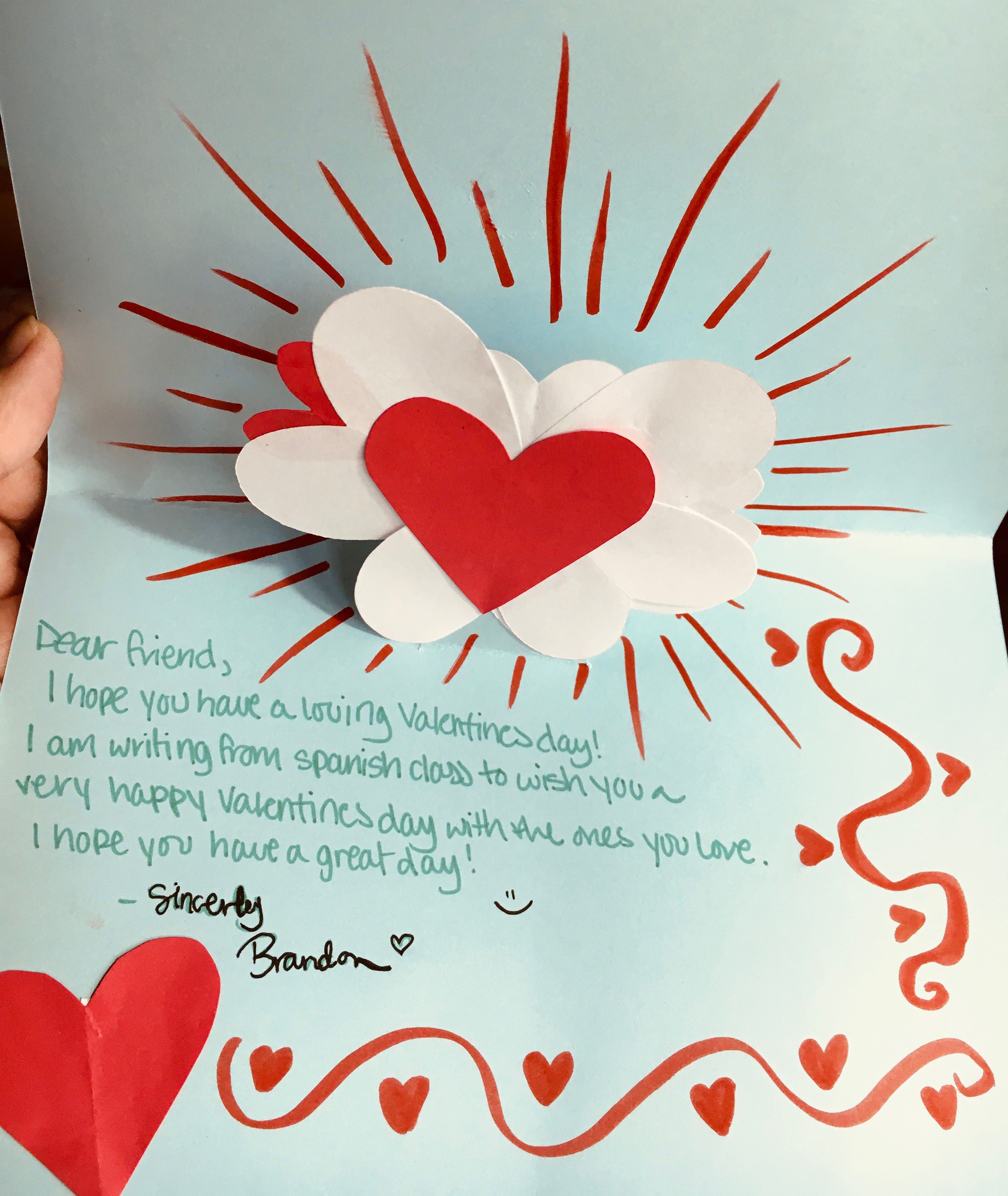
Today I'm excited because I was able to send 50 of these beautiful, hand-crafted Valentines to three different assisted-living homes to bless the residents with sunshine and send some warmth their way this winter.

0

Happy, Happy, Goose

What a week! I started my peace classes and we've had a blast talking about feelings, mindset, and superpowers. But, if I'm being totally honest, I have to share that something about teaching preK kiddos kind of worries me. Perhaps it's because my teacher training all those years ago was for a certification in secondary education. Or maybe it's because those preschool years are such a distant memory in my personal life. It's probably all of that, combined with the fact that I'm scared that they won't engage like my older learners, and then what? Whatever it is, those feelings always subside once we get going, and this week was no exception. I taught five preK classes and each one was more entertaining than the last!

We read this adorable little newcomer ...

Click this cover image for a book review 
and author interview.

... not because I think it's all that, but because it's a good one for  focusing on feelings and to assist in imaginary play. And play we did! We stopped on every page. We made motions and noises to show how to fly off a slide, we made our imaginary cupcakes disappear, we turned up our noses to the peas on the plate. We saw the mommy get mad like mommies sometimes do when we make a big mess. And {warning!} we felt a little embarrassed when we saw the bare bottom pop out of the water in the bathtub. We made happy faces, sad faces, mad faces, surprised faces, scared faces, and happy faces again. And it was a blast!

After we read, we played a riveting version of Duck, Duck, Goose with the feelings words Happy, Happy, Sad. It was obvious that some of the children had not ever played this game, but it didn't matter because they loved the 'chase me!' part for sure. A few of the ones who had played it cracked me up because they said Happy, Happy, Happy, Happy, Happy, Happy, Goose! as they circled up, touched our heads, and got ready to run. Then they'd cackle and squeal with delight. 
We had oh, so much fun playing with feelings.

Note to self: Sometimes Quite often our worries are bigger than anything that could really ever materialize. What superpower could help me embrace that as a life mantra to ward off worry?

Have  a happy, happy weekend.


3

Building Skills For Big Feelings

Today I'm excited because we're talking about 
one of my favorite topics: FEELINGS.

0